An IQ of 128 tends to draw curiosity because it sits close to the threshold where thinking starts to feel noticeably different from the norm. People look up this number for all sorts of reasons—comparison, self-understanding, or simple interest in how the scale works. Whatever the reason, this score usually reflects a mind that absorbs complexity quickly and doesn’t need much warming up before diving into new information.
IQ 128 doesn’t dictate your personality or the direction of your life, but it does suggest a certain ease with analyzing situations that others might describe as confusing or mentally tiring. For context, it can help to see how this score fits within the larger IQ test range, since numbers make more sense when viewed alongside the rest of the scale.
What Does a 128 IQ Score Mean?
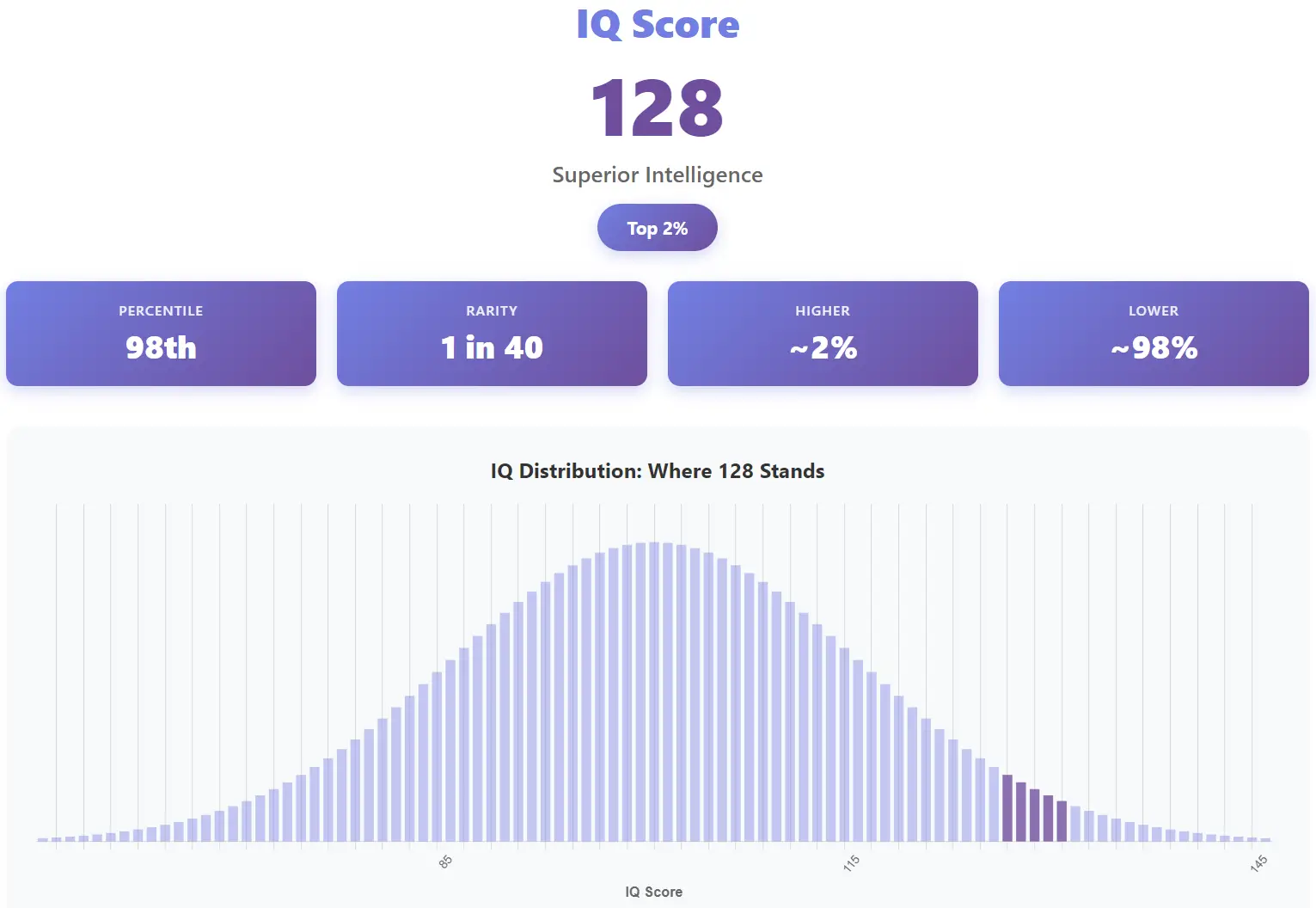
Most test publishers classify a score of 128 in the “very high” region. In statistical terms, it looks something like this:
-
Percentile rank: a bit above the 97th percentile
-
Rarity: around 1 in 40 people score this high
-
Population above: a very small minority
-
Standard deviations: just over 1.8 above average
In day-to-day life, this might show up as an ability to follow conversations that jump between topics quickly. You might notice when an argument relies on an assumption that hasn’t been stated, or sense when a plan looks neat on the surface but doesn’t hold up under pressure. People may describe you as “sharp,” but from your perspective, you’re simply noticing things that seem obvious once you see them.
This doesn’t mean everything comes instantly. You likely still hit roadblocks—especially when a subject is dull or the environment is chaotic. But once the pattern behind something becomes clear, you can usually build on it without needing much guidance.
Cognitive Tendencies Linked to IQ 128
This score doesn’t produce a single thinking style, but it often comes with certain tendencies that appear across many individuals in this range.
A habit of tracing causes
You might find yourself asking what led to a problem instead of reacting to the surface-level symptoms. This can make you the person others come to when something “doesn’t make sense.”
Quick reconstruction of missing parts
If someone gives you an incomplete explanation, you may fill in the missing pieces automatically. This can help in work and study, though it sometimes leads you to assume others see the same gaps you do.
An eye for contradictions
You may spot when two statements can’t both be true. You might not call it out every time, but you register it—and often adjust your expectations accordingly.
Focus that strengthens under pressure
You may think clearly when others start to get overwhelmed, especially in situations where the stakes rise or the time window shrinks.
Curiosity tied to usefulness
Instead of collecting random facts, you gravitate toward information that helps you solve a problem, improve a system, or understand something more deeply.
Professions and Careers for IQ 128
A score in this range opens doors across many fields. The bigger questions become: What kind of work pace do you like? How much uncertainty can you tolerate? And what type of problems hold your attention? Tools like Holland career theory can help narrow things down if you’re unsure where you fit.
Professional Fields
-
Economists analyze systems where small changes can ripple in unexpected ways.
-
Engineers design solutions where accuracy matters and trade-offs need to be considered carefully.
-
Judges and Legal Scholars interpret complex rules and competing interests without losing sight of nuance.
-
UX Strategists connect human behavior with digital design in ways that require both logic and intuition.
-
Medical Researchers investigate patterns in data and identify subtle relationships that guide treatment advances.
Technical and Analytical Work
-
Data Engineers build the systems that make large-scale analysis possible.
-
Algorithm Analysts refine processes so they run more efficiently or predictably.
-
Geospatial Analysts interpret mapping data to solve real-world planning challenges.
-
Systems Designers create workflows that keep organizations running smoothly.
-
Behavioral Analysts examine how people make decisions and why they act the way they do.
Creative and Strategic Work
-
Screenwriters build narratives that require long-term structure and emotional logic.
-
Strategic Planners help companies decide what to prioritize and what to drop.
-
Editors shape raw material into writing that flows and communicates clearly.
-
Game Mechanics Designers craft rules and systems that feel fair, engaging, and internally consistent.
Skilled Trades
Many people with high reasoning ability prefer concrete, hands-on work where the results are visible and immediate.
-
Precision Machinists work with tolerances that leave almost no room for error.
-
Industrial Technicians troubleshoot machinery and interpret unusual readings quickly.
-
Instrumentation Specialists calibrate systems where small misalignments cause big problems.

Educational Expectations
People with IQ 128 usually handle demanding academic paths comfortably, though interest plays a large role. Understanding rarely causes friction; long-term discipline and task management are where the challenges tend to appear.
Undergraduate level:
You should be able to manage STEM programs, theory-heavy majors, or writing-intensive degrees without hitting ability-based barriers.
Master’s level:
Fields involving detailed analysis, lab work, or original research—public policy, genetics, applied math, architecture—fit well when the motivation is there.
Doctoral level:
A PhD demands endurance more than raw intelligence. Success at this score is common when the topic genuinely holds your interest for several years.
Professional schools:
-
Law: requires precision with language and strong interpretation of complex material.
-
Medicine: involves both technical knowledge and the ability to stay calm during long, high-pressure periods.
-
MBA programs: call for strategic thinking, modeling, and judgment under uncertainty.
Famous People With IQ 128
Well-known figures rarely publish verified test results, but discussions about highest IQ celebrities occasionally mention people whose work reflects careful reasoning and quick adaptation.
-
Chris Pine is sometimes associated with higher-end estimates due to his ability to shift between genres and roles that require subtle interpretation.
-
Constance Wu is often noted for her precision in performance and her comfort moving between comedic and dramatic roles.
-
Bryan Cranston is frequently admired for the depth and control he brings to character work, which has led fans to speculate about a strong underlying cognitive profile.
Learning and Development
People near IQ 128 often notice that their performance swings depending on how engaged they feel. When something captures your attention, progress can be quick and absorbing. When it doesn’t, even simple tasks feel unnecessarily heavy. Understanding this pattern can prevent misunderstandings about “motivation.”
You might also find yourself improving methods without meaning to. Once the principle behind something clicks, you start adjusting or optimizing it. This can lead to clever shortcuts—or mistakes—depending on the situation. Over time, learning when to experiment and when to stay within the method becomes part of the skill set.
Learning new fields later in life is very realistic at this ability level. The bigger challenge is staying with it long enough to get through the awkward beginner phase, especially when progress feels slow or inconsistent.
What to Keep in Mind
An IQ of 128 is genuinely advantageous, but it doesn’t decide success on its own. People with this score end up in a wide range of careers and lifestyles. Some prefer intellectual intensity; others prefer stable routines. Some thrive in high-pressure environments; others avoid them completely. Intelligence helps, but it doesn’t replace judgment, habits, or self-awareness.
You’ll encounter people who exceed you in certain skills and match you in others, and your own interests will change over time. What matters most is how consistently you put your cognitive strengths to work—not the score printed on a report.
Want to Explore More?
Learn about your cognitive abilities, take or retake the IQ test to see how you perform.
