
What Does 127 IQ Score Mean?
An IQ of 127 reflects strong reasoning ability. Discover how this score fits into the broader IQ range and what it suggests about your strengths.
People look up an IQ of 127 for different reasons. Some have just seen the number on a report, others are simply curious about what it says about a person’s thinking. On paper, it looks high. In real life, it usually shows up as a mind that handles complexity with less strain than most, but still needs direction, practice, and good choices.
IQ 127 sits in a band where ideas can be picked up quickly, turned around, and tested from several angles without much warm-up. It doesn’t decide what you care about or how disciplined you are, yet it does hint at how easily you can work with abstract information. For extra context, it helps to see where this result sits within the broader IQ test range rather than treating it as a number in isolation.
What Does a 127 IQ Score Mean?
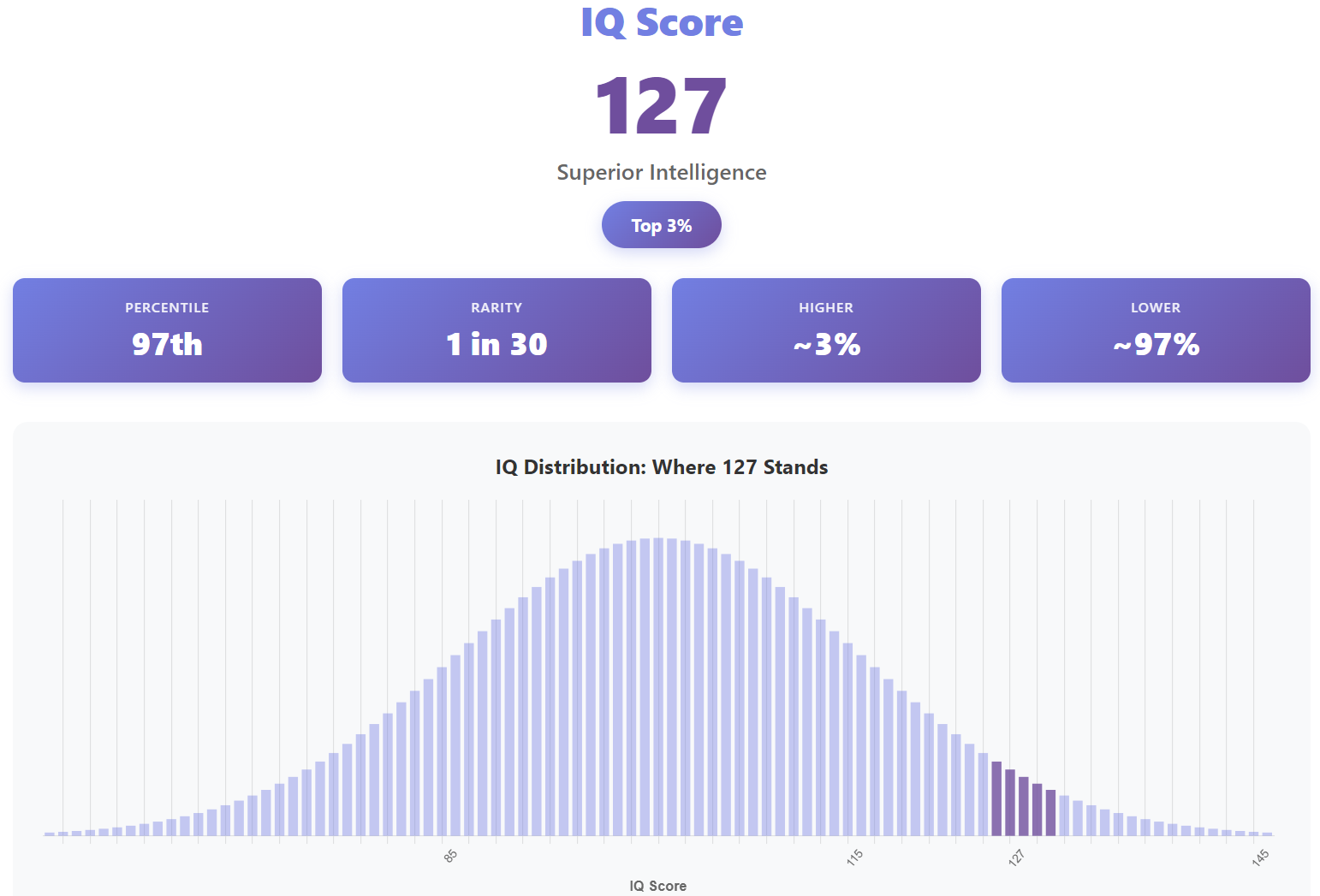
Statistically, an IQ of 127 can be described like this:
- Percentile rank: roughly the 97th percentile
- Rarity: around 1 in 35 people reach or exceed this level
- Population above: only a small slice of the population scores higher
- Standard deviations: close to 1.8 above the average
Day to day, this might look like arriving at the point of a discussion before others do, even if you don’t say it out loud. When someone explains a process, you may understand not only the steps but also where that process could fail, how it could be improved, or which parts are unnecessary. In group work, you may notice you’re tracking side effects and second-order consequences while others are focused on the immediate task.
This doesn’t mean you never get tangled in your own thoughts. People with IQ 127 still procrastinate, misjudge situations, or overcomplicate simple decisions. The difference is that once you decide to untangle the problem, you usually have the mental tools to do it, provided you actually apply them.
Cognitive Tendencies Linked to IQ 127
There isn’t a single “127 way of thinking,” but some patterns do show up more often in people around this level.
Layered understanding
You can hold several parts of a situation in mind at once. While others might lock onto one detail, you’re weighing timing, trade-offs, side effects, and who will be affected if one piece moves.
Flexible perspective-taking
It’s usually not hard for you to switch sides in an argument and see what still holds up. You can find strengths and weak spots on both sides, which is useful in planning, negotiation, and conflict resolution.
Quick mental modeling
When someone describes a system—technical, social, or organizational—you often build an internal map of it without much effort. Once that map exists, you can run “what if” scenarios in your head and anticipate problems before they appear.
On–off attention
You might drift through topics that don’t feel relevant, yet lock in strongly when something catches your interest. In those focused stretches, you can move through material or ideas faster than most people around you.
Independent sense-making
You probably remember the logic behind a method more easily than the exact steps. Once the pattern clicks, you don’t need much repetition and start adapting the approach to your own style.
Professions and Careers for IQ 127
At this level, a wide range of careers is available if other pieces of your life line up. Ability is rarely the main barrier. Values, temperament, tolerance for stress, and the kind of problems you enjoy working on matter far more. If you’re trying to narrow options, frameworks like Holland career theory can help you match your personality and interests to work settings that actually feel sustainable.
Professional Fields
- Psychiatrists draw on medical knowledge and psychological insight to make sense of complex personal histories and symptoms.
- Policy Analysts read research, evaluate data, and turn it into clear recommendations for governments or organizations.
- Software Architects decide how different parts of a large system should interact and evolve as requirements change.
- Academic Researchers in areas like economics, physics, or linguistics work on questions that don’t have a template solution.
- Risk Managers design ways to anticipate and contain problems in finance, engineering, or operations.
Technical and Analytical Work
- Quantitative Analysts build and test models that influence trading, pricing, or risk decisions.
- Operations Researchers untangle scheduling, logistics, and resource allocation using math and real-world constraints.
- Bioinformatics Specialists interpret complex biological data and write tools to work with it efficiently.
- Cybersecurity Analysts think through how systems can be attacked and reinforce weak points before that happens.
- Product Analysts connect user behavior, metrics, and business goals to guide product changes.
Creative and Strategic Work
- Showrunners and Series Creators keep track of story arcs, character development, and production limits across many episodes.
- Creative Directors steer brand voice, visuals, and messaging so they line up over time instead of feeling random.
- Long-form Journalists gather documents, interviews, and data, then turn them into narratives with nuance and structure.
- Narrative Designers in Interactive Media build worlds where player choices matter, which requires both imagination and strict internal logic.
Skilled Trades
Plenty of people with higher IQ scores choose hands-on work, especially where mistakes are costly and judgment matters more than titles.
- Aircraft Mechanics maintain systems where small errors can have serious consequences, so methodical reasoning is essential.
- Master Electricians design, install, and troubleshoot complex electrical layouts in homes, offices, or industrial sites.
- Power Plant Operators watch over systems, interpret readings, and respond when something starts drifting away from normal.

Educational Expectations
With an IQ of 127, demanding academic paths are open if you choose to pursue them. The real questions usually revolve around motivation, time, money, and life responsibilities rather than pure mental capacity.
Undergraduate level:
Degrees with heavy math, theory, or project work are realistic. Many people at this level report that the hardest part is staying organized and dealing with deadlines, not understanding the actual material.
Master’s level:
Programs centered on analysis, modeling, or advanced practice—such as statistics, computer science, public health, or philosophy—sit comfortably within this range. Dense reading and complex assignments can be handled with consistent effort.
Doctoral level:
PhD work demands patience more than perfect scores. People around IQ 127 do well when they pick a topic they can stay genuinely curious about, even when progress slows and feedback is scarce.
Professional schools:
- Law relies on structured argument, close reading, and precise writing.
- Medicine is intellectually manageable here; the grind comes from long training, responsibility, and emotional load.
- MBA programs ask you to think in systems, compare trade-offs, and interpret financial and operational data.
Famous People With IQ 127
IQ numbers attached to public figures are usually based on loose estimates rather than verified testing. Still, discussions about highest IQ celebrities sometimes mention certain names around this range. These mentions don’t confirm anything, but they give a general sense of how people imagine intelligence showing up in different careers.
- Chris Pratt is occasionally linked with estimates in this range. His ability to switch between comedic timing, action roles, and more serious performances has led some fans to assume a strong underlying cognitive range.
- Neil Patrick Harris is often mentioned because of his long-running career across television, theater, and hosting, all of which demand quick thinking, memory, and strong situational awareness.
- Jodie Comer is sometimes included in discussions about higher IQ estimates due to her unusually precise character work, her ear for accents, and the level of detail she brings to emotionally layered roles.
Learning and Development
People around IQ 127 sometimes notice a sharp contrast between how they perform when they care and how they perform when they don’t. When a topic feels meaningful, progress can be quick. When it doesn’t, even simple tasks can stall. Seeing that distinction clearly helps you plan around it instead of blaming your entire personality.
Another recurring pattern is a tendency to adjust methods on the fly. Once you grasp the core idea, you might start bending or skipping steps. In creative work this can lead to original solutions. In more constrained fields, it can create avoidable errors early on. Part of maturing intellectually is learning where improvisation adds value and where it’s better to follow the established path first.
Later in life, switching fields, going back to school, or learning a technical skill from scratch is usually very possible at this level. The sticking point is less “Can I do it?” and more “Am I willing to be a beginner again and stick with it long enough to reach competence?”
What to Keep in Mind
An IQ of 127 gives you real leverage, but it doesn’t resolve questions about direction, priorities, or character. People with similar scores end up as researchers, founders, managers, artists, tradespeople, teachers, or parents who prefer a quieter life. The number doesn’t tell you which of those options will feel like a good use of your time.
You’ll meet people who surpass you in particular skills, and others who match your raw ability but make very different choices with it. That isn’t a threat to your intelligence; it’s a reminder that outcomes depend on more than one trait. Combining your cognitive strengths with steady habits, emotional awareness, and a willingness to keep learning usually matters more than the score that started you thinking about all of this.
Want to Explore More?
Learn about your cognitive abilities, take or retake the IQ test to see how you perform.
First and world's best testing platform. For everyone who has questions about themselves and wants answers too
Company BM
Vitosha Blvd 66, floor 4, 1463 Sofia
2026