
What Does 125 IQ Score Mean?
IQ 125 means you're smarter than 95% of people. Explore your cognitive strengths, professional paths that match your abilities, and education opportunities available to you.
Your IQ test came back with a score of 125. You're wondering where that puts you and what it means for your life.
A 125 IQ means you've outperformed about 95 out of every 100 people who take the same test. It's firmly in the superior intelligence range. The score matters, but what you choose to do with that cognitive capacity matters more.
What Does a 125 IQ Score Mean?
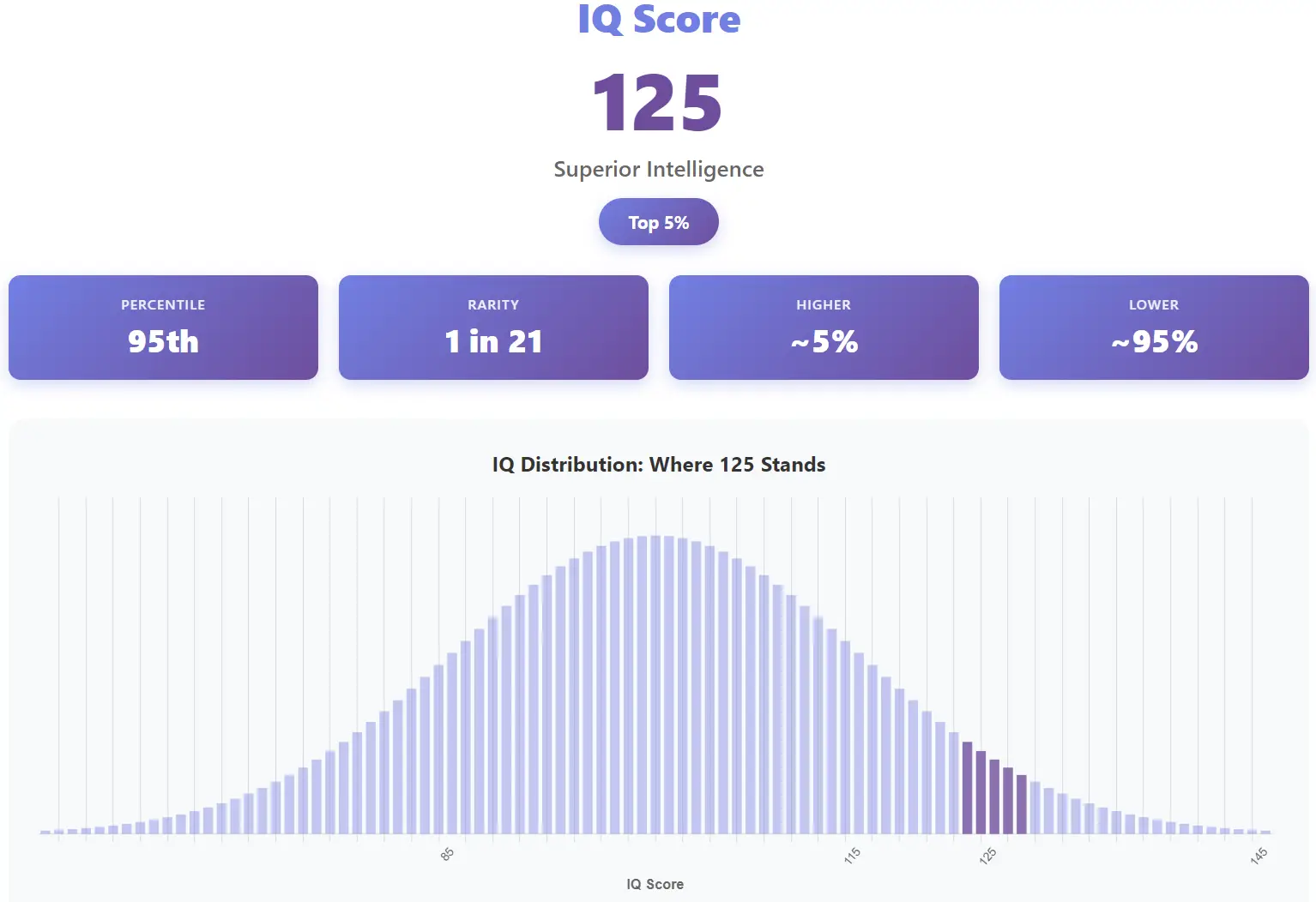
A 125 IQ puts you in a cognitive range that most people won't reach. The numbers:
Your Statistical Position:
- Percentile rank: 95th percentile
- Rarity: Roughly 1 in 21 people score at this level or above
- Distribution: About 5% of the population scores higher than you
- Standard deviations: 1.67 standard deviations above average
If you took 100 random people and tested them all, you'd likely beat 95 of them.
Real-World Implications
School probably felt manageable to you in ways it didn't for most of your peers. When other students complained about difficult material, you understood what they meant but didn't share the same level of struggle. Group projects often meant you ended up doing more than your share because you finished your portion quickly and could help others catch up.
You've probably developed a habit of double-checking things others say or present as fact. Not out of distrust necessarily, but because you notice logical gaps, unsupported claims, or oversimplifications. You fact-check instinctively. Sometimes this makes you popular as the person who catches errors. Sometimes it makes you unpopular as the person who points them out.
Don't expect to coast on intelligence alone in competitive environments. Medical schools, top law firms, tech companies, research universities attract people who score in your range or higher. Your IQ is a solid foundation, but many people around you will have comparable or superior cognitive abilities.
Cognitive Strengths at IQ 125
Scoring 125 typically correlates with specific cognitive patterns.
Information synthesis is probably one of your strengths. You can take data from multiple sources, identify what's relevant, and create a coherent understanding. Where others get lost in details or overwhelmed by volume, you can extract signal from noise. This makes research tasks, due diligence, and making sense of complex situations easier for you.
You likely have above-average fluid intelligence. This means you can solve novel problems you've never encountered before. You don't need someone to have shown you the exact solution method. You can figure out new approaches by applying logic and reasoning. This adaptability serves you well when facing unfamiliar challenges.
Deductive reasoning comes easily. If A implies B, and B implies C, you immediately see that A implies C. Formal logic, mathematical proofs, legal reasoning, debugging code all rely on this ability. You can trace chains of causation and spot where arguments break down.
Your processing speed is likely faster than average. You can read quickly while maintaining comprehension, work through problems efficiently, and make decisions without excessive deliberation. This doesn't mean you're always fast, but when speed matters, you can deliver.
You probably have strong metacognition. You think about your own thinking. You notice when you're confused, recognize when you need more information, and can evaluate whether you truly understand something or just think you do. This self-awareness makes you a more effective learner.
Professions and Careers for IQ 125
With an IQ of 125, cognitive demands won't limit your career choices. The question is what type of work aligns with your interests and values.
Professional Fields
- Neurosurgeons operate on the brain and nervous system. The career requires exceptional training, steady hands, and the ability to make critical decisions under pressure. The intellectual demands are high but manageable for you.
- Constitutional lawyers argue cases involving fundamental rights and governmental powers. You'd need both legal expertise and the ability to construct sophisticated arguments. The work is intellectually stimulating and socially significant.
- Aerospace engineers design systems for aircraft and spacecraft. You'd work on propulsion, aerodynamics, materials, or avionics. The technical complexity is significant, but you have the cognitive tools to handle it.
- Epidemiologists study disease patterns in populations. You'd design studies, analyze data, and inform public health policy. The work combines statistics, biology, and practical problem-solving.
- Investment bankers structure deals, raise capital, and advise on mergers and acquisitions. The work demands analytical thinking, financial modeling, and the ability to work under intense time pressure.
Technical and Analytical Work
- Theoretical physicists develop models of how the universe works. You'd explore questions about fundamental forces, particles, or cosmology. The work requires advanced mathematics and creative thinking about abstract concepts.
- Cybersecurity architects design secure systems at an organizational level. You'd think like an attacker while building defenses. The work demands technical depth and strategic thinking.
- Algorithm designers create efficient solutions to computational problems. Whether for search engines, recommendation systems, or optimization, you'd work on making computers solve problems faster and better.
- Econometricians apply statistical methods to economic data. You'd test theories, forecast trends, and provide quantitative analysis to guide policy or business decisions.
- Genetic counselors interpret genetic test results and help patients understand their implications. The role requires understanding complex genetics while communicating sensitively about difficult topics.
Creative and Strategic Work
- Investigative journalists uncover stories that others miss. The work requires research skills, critical thinking, and the ability to verify information while working under deadline pressure.
- Game designers create rules, mechanics, and systems for games. You'd balance complexity with accessibility, create engaging challenges, and think through countless player decisions.
- Political strategists develop campaigns and communication strategies. You'd analyze polling data, understand demographic trends, and craft messages that resonate with target audiences.
- Composers and arrangers create original music or adapt existing works. While creativity drives the work, understanding music theory, structure, and orchestration requires analytical thinking.
Skilled Trades
Don't overlook skilled trades. Many tradespeople score in your IQ range and earn excellent incomes.
- Boilermakers build and repair large vessels that hold liquids and gases. The work involves reading blueprints, working with industrial equipment, and solving structural problems. It pays well and requires real skill.
- Air traffic controllers manage aircraft movement in controlled airspace. The job demands spatial awareness, quick decision-making, and the ability to track multiple aircraft simultaneously under high-stakes conditions.
- Sonographers operate ultrasound equipment to create diagnostic images. The role requires anatomical knowledge, technical skill, and the ability to identify abnormalities that doctors need to see.
Your career should reflect what you find meaningful and how you want to spend your working life.

Educational Attainment Expectations
College degrees in any discipline are achievable. Engineering programs demand serious work, but you can meet the challenge. Pure sciences like physics and chemistry are accessible. Mathematics programs are within reach. Whatever major interests you, the intellectual requirements won't block you.
Master's programs are realistic across all fields. Competitive programs will evaluate your entire application, but your cognitive abilities support success in graduate coursework. Whether you're pursuing an MS, MA, or professional master's, you have the mental tools to complete the degree.
Doctoral programs are achievable even at highly selective institutions. A 125 IQ puts you in the range where most PhD students fall. Getting admitted depends on research fit, recommendations, and demonstrated potential, but intellectual capacity isn't your barrier. Completing a dissertation requires persistence more than raw intelligence.
Professional school paths:
- Law schools across the top 20-25 are realistic with strong LSAT performance. Your IQ correlates with scoring in the range these schools expect. Your undergraduate record and application quality matter, but you're cognitively qualified.
- Medical schools are accessible with strong academic performance. You can handle the MCAT and the demanding coursework. Admission depends on your complete application, but intelligence isn't your limiting factor.
- MBA programs at top schools value professional accomplishments alongside academic ability. You can excel in the analytical coursework. Your pre-MBA career trajectory influences admission more than your IQ.
Famous People With IQ 125
Celebrity IQ scores are usually estimates rather than confirmed test results, so view these skeptically. Some well-known figures reportedly score around 125.
1. Chris Hemsworth reportedly has an IQ around 125. The Australian actor has successfully transitioned from television to major film franchises while also producing projects and managing business ventures.
2. Gal Gadot has been estimated at 125. The Israeli actress served two years in the military, studied law, and speaks multiple languages while building an international acting career.
3. John Legend is sometimes cited at 125. He was accepted to Harvard but attended the University of Pennsylvania instead, graduating with a degree in English with an emphasis on African American literature before his music career.
Learning and Development Considerations
You probably find passive learning frustrating. Sitting through lectures where information is presented slowly, or training sessions that over-explain simple concepts, feels like wasted time. You'd rather read the material yourself at your own pace. Active learning, where you engage directly with problems, suits you better than passive consumption of information.
Your work satisfaction likely depends heavily on intellectual engagement. Jobs that challenge you to think, adapt, and solve problems keep you interested. Work that's purely procedural or where you're executing predefined processes without room for judgment will feel unfulfilling. You need complexity to stay engaged.
You might have noticed that you sometimes come across as impatient in conversations. When someone takes a long time to explain something you grasped immediately, or when discussions circle around a point you understood early on, staying engaged requires effort. Being aware of this helps in collaborative settings.
Your ability to learn new things remains strong throughout life. Career changes at 35, 45, or 55 are feasible. You can acquire new technical skills, master unfamiliar domains, or earn additional credentials later in life. Your cognitive advantage doesn't expire with age.
What to Keep in Mind
Your intelligence gives you capability, not outcomes. If you pursue something difficult and fall short, intelligence won't be why. The reasons will be other factors like preparation, resources, timing, or circumstances beyond your control. Don't attribute failure to cognitive limits when other explanations are more accurate.
Smart people will surround you in competitive fields. Get used to it. Some will be smarter than you, many will match you, and being around intelligent people makes you better. If you need to be the smartest person in every room to feel good about yourself, you'll either end up in the wrong rooms or feeling bad.
People with your IQ follow wildly different life paths. Some become leaders in their fields. Others have ordinary careers and lives. The score creates possibilities but doesn't determine which ones you'll pursue or achieve. Your choices, circumstances, effort, and character shape outcomes more than your test score.
An IQ of 125 is a genuine advantage. Make use of it. Tackle problems that matter, build things that last, and help others along the way. Those things count more than the number.
Want to Explore More?
Learn about your cognitive abilities, take or retake the IQ test to see how you perform.
First and world's best testing platform. For everyone who has questions about themselves and wants answers too
Company BM
Vitosha Blvd 66, floor 4, 1463 Sofia
2026