
What Does 123 IQ Score Mean?
Understanding your IQ 123: where you rank statistically, which careers suit your cognitive profile, education paths to consider, and how to leverage your intelligence.
So you tested at 123 IQ. You're looking for context on what that actually means beyond just a number.
A 123 IQ puts you ahead of roughly 94% of the population. It's classified as superior intelligence. The number gives you some information about your cognitive abilities, but it's what you do with those abilities that determines your trajectory.
What Does a 123 IQ Score Mean?
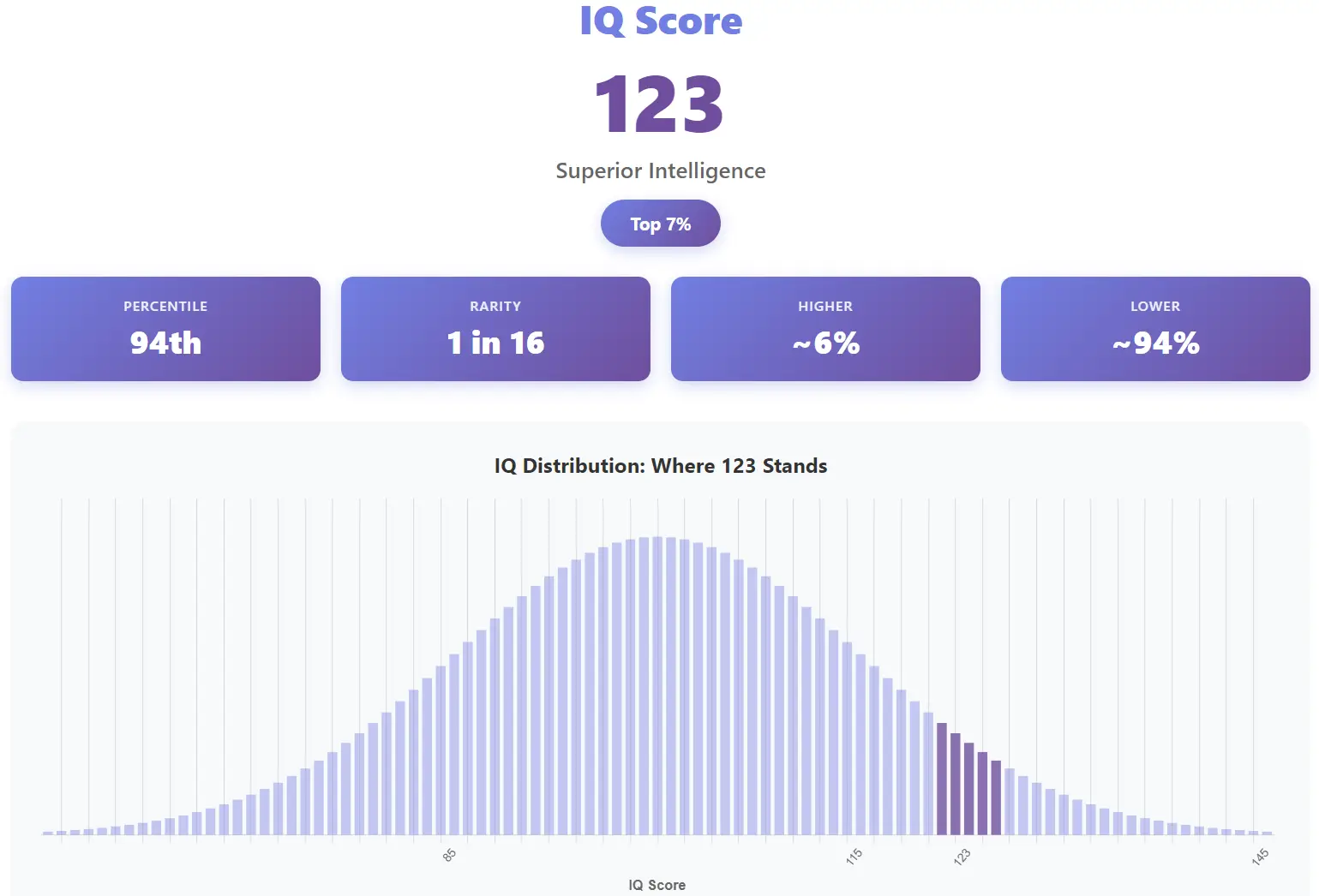
Scoring 123 means you're performing well into the superior range on standardized cognitive assessments. Here's the statistical breakdown:
Your Statistical Position:
- Percentile rank: 94th percentile
- Rarity: Approximately 1 in 16 people score at this level or above
- Distribution: Only about 6% of people score higher than you
- Standard deviations: 1.53 standard deviations above the mean
In practical terms: gather 100 people randomly, and you'd likely outperform 94 of them on similar cognitive tests.
Real-World Implications
You were probably the kid who finished tests early. Not because you rushed, but because you worked through questions faster than most of your peers. Concepts that took your classmates a week to grasp made sense to you in a day or two. Teachers sometimes pulled you aside to give you extra work because you'd already finished what everyone else was doing.
Now, you're the go-to problem solver in your circle. When something breaks, when plans fall apart, when nobody can figure out why the numbers don't add up—people turn to you. You have a knack for seeing what's wrong and knowing how to fix it. This happens so naturally you might not even realize it's a skill others lack.
Don't assume you'll always be the smartest person around, though. In universities, tech companies, law firms, and other professional environments, you'll work alongside people just as sharp or sharper. Your intelligence is a genuine asset, but it won't make you exceptional in every context.
Cognitive Strengths at IQ 123
Scoring at this level typically indicates several cognitive advantages.
You process verbal information quickly. Reading comprehension is easy for you. You can skim a document and pull out the key points without getting bogged down in details. In conversations, you follow complex arguments without needing them simplified. You probably express yourself clearly in both writing and speech without much conscious effort.
Logical reasoning is one of your strong points. If-then statements, cause-and-effect relationships, spotting logical fallacies—these come naturally. You can evaluate arguments critically and identify when something doesn't add up. This makes you good at debugging errors, whether in code, in business plans, or in everyday reasoning.
You're comfortable with uncertainty and ambiguity. When information is incomplete or contradictory, you don't panic. You can operate with partial data, make reasonable assumptions, and adjust as you learn more. Many people need everything spelled out completely. You can work with gaps.
Your spatial reasoning is probably above average. You can visualize objects rotating, imagine how pieces fit together, or understand maps and diagrams without much difficulty. This helps in everything from assembling furniture to understanding complex systems.
Mental flexibility allows you to shift perspectives. You can look at a problem from multiple angles, consider different stakeholders' viewpoints, or switch between different types of analysis. This adaptability is valuable in complex situations where rigid thinking fails.
Professions and Careers for IQ 123
Intellectually, you're qualified for demanding professional work. The cognitive barriers are gone. Now it's about what you want from your career and your life.
Professional Fields
- Physicians, surgeons, and medical specialists are cognitively within your range. The path is long and demanding, but your intelligence isn't the limiting factor. Specialties like radiology, pathology, or anesthesiology suit analytical minds.
- Attorneys in various practice areas can leverage your logical reasoning. Trial law, corporate law, and intellectual property—all are options. The bar exam and law school are manageable hurdles.
- Engineers across disciplines can use your problem-solving abilities. Structural, aerospace, chemical, biomedical—pick based on interest. The technical demands won't overwhelm you.
- University professors and researchers can pursue deep expertise in their fields. If you enjoy learning and discovery, academia offers that path. Getting a PhD and publishing research are realistic goals.
- Senior business executives often score in your range. Strategic thinking, decision-making under uncertainty, and managing complexity are part of the job. C-suite positions are within reach if you develop the right experience.
Technical and Analytical Work
- Cybersecurity specialists protect systems and data. The work involves understanding both technical vulnerabilities and how attackers think. Your logical reasoning helps here.
- Quantitative analysts in finance use mathematics and statistics to model markets and price securities. If you enjoy working with numbers and probability, this field pays well.
- Machine learning engineers build AI systems. The work combines programming, mathematics, and problem-solving. Your cognitive abilities make this accessible.
- Biostatisticians analyze medical and biological data. You'll work on clinical trials, epidemiological studies, or genetic research. The field blends statistics with real-world impact.
- Systems architects design complex technical infrastructure. You'll need to see the big picture while understanding technical details. Your mental flexibility helps with this balance.
Creative and Strategic Work
- Urban planners shape how cities develop. The work requires understanding demographics, economics, environmental science, and politics simultaneously. Your ability to juggle multiple factors is useful.
- Creative directors in advertising combine artistic vision with strategic thinking. You'll develop campaigns that both look good and achieve business objectives.
- Screenwriters and authors create narratives. While creativity matters most, strong verbal skills and the ability to structure complex plots help significantly.
- Policy analysts research and recommend government or corporate policies. You'll analyze data, consider trade-offs, and communicate recommendations clearly.
Skilled Trades
Skilled trades offer good money and intellectual engagement for people scoring in your range.
- Elevator mechanics work with complex mechanical and electrical systems. Troubleshooting requires real problem-solving, and the pay is excellent.
- Aircraft mechanics maintain sophisticated machines where precision matters. The work is technical and pays well.
- Industrial electricians handle high-voltage systems in manufacturing facilities. The work is challenging and compensated accordingly.
Your career should align with your interests and lifestyle preferences, not just your test score.

Educational Attainment Expectations
Undergraduate education in any field is accessible. STEM programs require dedicated study, but you can handle the material. Humanities and social sciences give you room to explore while excelling academically. Your performance depends more on how much effort you invest than on cognitive limits.
Master's programs are realistic across disciplines. You'll compete successfully for admission at reputable universities. Whether you pursue an MS, MA, or professional master's degree, the intellectual demands are within your capabilities. Funding and time commitments matter more than raw ability.
Doctoral programs are achievable if research interests you. Even the most competitive programs aren't intellectually out of reach, though they select from many qualified candidates. Most PhD programs in most fields will accept you if your application demonstrates genuine research potential and commitment.
For professional graduate programs:
- Law school is realistic. Your IQ correlates with scoring well on the LSAT, which opens doors throughout the top 50 law schools. Success in law school depends on work habits as much as aptitude.
- Medical school evaluates your complete application. Your cognitive abilities support strong MCAT performance. Clinical experience, research, and interpersonal skills round out what admissions committees want to see.
- MBA programs value professional accomplishments alongside academic ability. You can handle the quantitative coursework and case analysis. Your career trajectory before business school matters most.
Famous People With IQ 123
Most celebrity IQ numbers are estimates rather than confirmed scores, so treat them skeptically. Some notable figures are reported around 123.
1. Blake Lively reportedly scores around 123. The actress has built a successful career in film and television while also launching business ventures and advocacy work.
2. Jake Tapper has been estimated around 123. The CNN anchor and journalist studied history and political science before building his career in broadcast journalism and writing several books.
3. Emily Blunt is sometimes cited at 123. The British actress has demonstrated range across genres from drama to action to musicals, earning critical acclaim and major film roles.
Learning and Development Considerations
You learn most effectively when you can see the practical application. Abstract theory for its own sake might bore you, but understanding how concepts apply to real problems keeps you engaged. Hands-on experience combined with theoretical knowledge works better for you than pure lecture or pure practice alone.
You probably need intellectual stimulation in your work environment. Jobs where you're solving the same problem repeatedly will feel stifling. Positions that offer new challenges, require continuous learning, or let you tackle diverse issues will keep you satisfied. Stagnation bothers you more than most people.
Communication with people who think differently requires adjustment on your part. You might assume others follow your reasoning automatically when they don't. Slowing down to explain your logic, providing examples, and checking for understanding prevents frustration on both sides. Being a good communicator is a separate skill from being intelligent.
Your cognitive abilities remain strong throughout life. Career transitions at any age are viable. People with your IQ successfully retrain in new fields in their 30s, 40s, 50s, and beyond. Age might slow you slightly, but you'll still outperform most people in learning new skills.
What to Keep in Mind
If you're pursuing something intellectually demanding, lack of intelligence won't stop you. If you don't achieve your goals, it'll be for other reasons: insufficient preparation, lack of persistence, poor timing, or factors beyond your control. Don't blame intelligence or lack thereof.
You'll regularly encounter intellectual equals and superiors in competitive environments. This is healthy. Being surrounded by smart people pushes you to grow. If you're always the smartest person in the room, you're probably in the wrong room.
People with your IQ follow very different life paths. Some build extraordinary careers. Others live ordinary lives. The score predicts potential but not outcomes. Your decisions, circumstances, relationships, and resilience determine where you end up.
A 123 IQ is a real advantage, but it's not a guarantee of anything. What matters is whether you develop your abilities, pursue meaningful goals, and contribute something of value. Make it count.
Want to Explore More?
Learn about your cognitive abilities, take or retake the IQ test to see how you perform.
First and world's best testing platform. For everyone who has questions about themselves and wants answers too
Company BM
Vitosha Blvd 66, floor 4, 1463 Sofia
2026