
What Does 120 IQ Score Mean?
Discover what an IQ score of 120 really means. Learn how rare it is, where it ranks on the IQ scale, and what this above-average score says about your abilities.
You scored 120 on an IQ test. What does that actually mean? Is it good? Where do you stand?
An IQ of 120 puts you in the top 10% of the population. It's solidly above average. Psychologists call this the "superior intelligence" range. Before you get too excited, though, we should talk about what this score actually means for your life.
What Does a 120 IQ Score Mean?
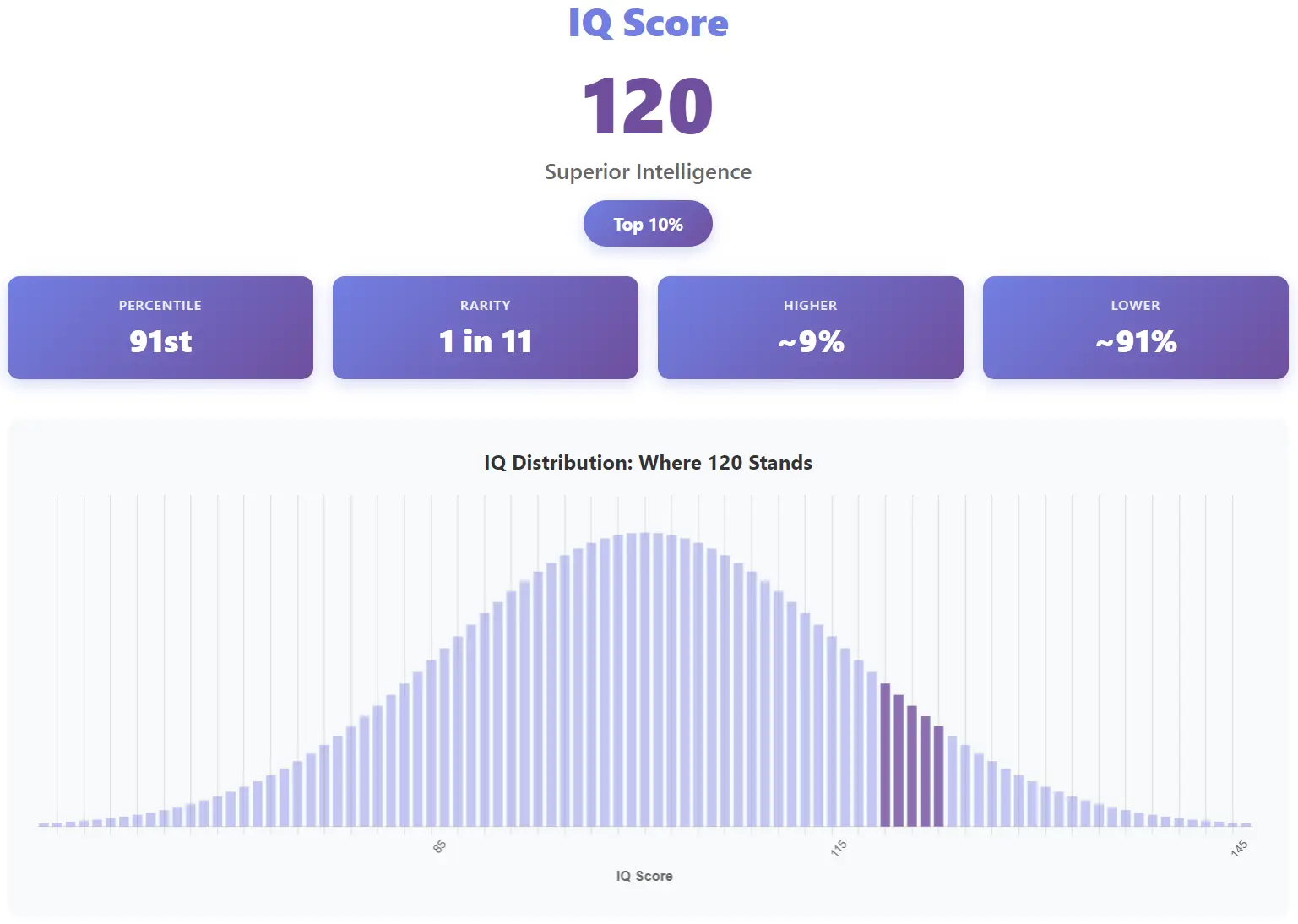
A score of 120 places you in the "superior intelligence" category by standard classification systems. Here's the breakdown:
Where You Stand:
- Percentile rank: 91st percentile
- How common is it: About 1 in 11 people score 120 or higher
- The math: Roughly 9% of people score above you, 91% score below
- Standard deviations: 1.33 standard deviations above the mean
Put it this way: if you walked into a room with 100 random people, statistically only about 9 others would match or beat your score.
What This Actually Looks Like
School probably came easier to you than most of your classmates. When teachers explained new concepts, you got it on the first or second try while others needed more repetition. Abstract thinking feels natural. You're comfortable with theoretical discussions. You can connect ideas that seem unrelated.
Problem-solving happens efficiently for you. Whether you're debugging code, figuring out why a business strategy isn't working, or planning errands, you land on solutions without getting stuck too long. Graduate-level education is within reach if you want it.
Here's the thing: an IQ of 120 is high enough to handle demanding intellectual work. It's also common enough that you'll regularly run into people at your level or higher in professional settings. You're smart. You're just not the smartest person in most rooms where educated professionals gather.
Cognitive Strengths at IQ 120
A score of 120 indicates some specific cognitive advantages.
You absorb new information faster than about 90% of people. That doesn't make everything easy, but you need fewer repetitions to master new skills or concepts. Foreign languages, technical skills, complex procedures become manageable with consistent practice.
Theoretical concepts don't throw you. Philosophy, advanced mathematics, strategic planning, systems thinking—these aren't just accessible to you. They're areas where you can excel. You see patterns and connections that many people miss.
Multi-step problems with several moving pieces don't overwhelm you. You can hold multiple pieces of information in working memory while manipulating them to reach solutions. This applies whether you're troubleshooting technical issues, planning projects, or analyzing data.
Standardized tests probably went well for you. College coursework was manageable without heroic effort. You likely graduated with decent grades, even if you weren't always putting in maximum effort.
Reading complex texts, understanding nuanced arguments, and articulating your own thoughts clearly come naturally. You probably have a solid vocabulary and can explain complicated ideas in ways others understand.
Professions and Careers for IQ 120
An IQ of 120 opens doors to virtually any career path. You're intellectually equipped for work that most people would find too demanding.
Professional Careers
- Engineering (mechanical, electrical, civil, software) - You can handle the mathematics, spatial reasoning, and problem-solving these fields require.
- Business Management - Strategic planning, operations management, and business analysis suit your analytical abilities. Many successful executives score in the 115-125 range.
- Healthcare - Nursing, pharmacy, and physician assistant roles fit well. Medical school is achievable, though the most competitive specialties (neurosurgery, interventional radiology) tend to attract people scoring 125+.
- Law - You can handle law school and legal practice. Contract law, corporate law, family law are all intellectually manageable.
- Teaching - Secondary education and college-level teaching align well with your abilities, particularly in subjects you're passionate about.
Technical and Analytical Fields
- Data Analysis - Working with large datasets, identifying trends, and making data-driven recommendations fits your analytical strengths.
- Software Development - Programming, systems architecture, and technical problem-solving are accessible. You might not be the legendary 10x developer, but you can build a solid career.
- Financial Analysis - Investment analysis, accounting, and financial planning match your capabilities.
- Research - You can contribute meaningfully to research in various fields, particularly in applied research and implementation.
- Quality Assurance - Both in tech and manufacturing, roles requiring systematic problem identification suit your cognitive profile.
Creative and Strategic Roles
- Marketing Strategy - Developing campaigns, analyzing market trends, and strategic positioning work well with your analytical and creative capabilities.
- User Experience Design - Balancing technical constraints with human psychology and design principles fits your cognitive style.
- Product Management - Coordinating between technical teams, business stakeholders, and user needs leverages your ability to see multiple perspectives.
- Writing and Editing - Technical writing, journalism, and content strategy all benefit from your verbal comprehension and analytical abilities.
Skilled Trades
An IQ of 120 doesn't mean you should only pursue traditionally "intellectual" careers. You're more than capable of excelling in skilled trades, and many people in these fields score in your range.
- Electrical Work - Understanding electrical systems, reading schematics, and troubleshooting complex problems align with your cognitive strengths.
- HVAC - Modern HVAC work involves system diagnostics, understanding thermodynamics, and problem-solving suitable for your IQ level.
- Precision Manufacturing - CNC programming, toolmaking, and quality control can be intellectually engaging and financially rewarding.
The real question is interest, temperament, and lifestyle preferences.

Educational Attainment Expectations
College should be manageable across any major. STEM fields will require work, but they aren't out of reach. Liberal arts, business, social sciences—you can handle these without excessive struggle. Your grades will depend more on work ethic and interest than raw cognitive ability.
Most master's programs are realistic goals. MBA programs, master's in engineering, education, social work, and public administration are all accessible. You'll be competitive for admission at solid regional universities and many well-regarded national programs.
PhD programs are achievable, though the most competitive programs in fields like physics, mathematics, or philosophy tend to attract candidates scoring 125+. You can complete doctoral work, but you might find the top-tier programs challenging to enter based on competition.
For professional schools:
- The LSAT correlates with IQ, and a score of 120 typically translates to solid LSAT performance. Most law schools are realistic options.
- You can handle the academic demands of medical school. Admission depends heavily on undergraduate performance and MCAT scores, but you're not intellectually barred from medicine.
- MBA programs value work experience and leadership as much as cognitive ability. You're intellectually prepared for any program.
Famous People With IQ 120
Celebrity IQ scores are usually estimated rather than confirmed, so take these with some skepticism. Several notable figures have been reported to have IQ scores around 120.
1. Angelina Jolie has been reported to have an IQ of 120. Beyond acting, she's a filmmaker and humanitarian. She's worked as a UN Special Envoy and manages substantial philanthropic operations. She's directed several films.
2. Chris Brown, the R&B artist, reportedly scores around 120. His musical output shows pattern recognition and creative problem-solving. He produces much of his own music and has mastered multiple instruments.
3. Miley Cyrus has also been reported to score 120 on IQ tests. Her transition from child star to business owner managing multiple entertainment ventures shows strategic thinking.
Learning and Development Considerations
With an IQ of 120, you probably benefit from learning approaches that provide conceptual frameworks first, then fill in details. You grasp the "why" behind concepts quickly, which helps you retain information and apply it flexibly. Rote memorization likely feels tedious because you instinctively look for underlying patterns and principles.
You thrive in settings that value analysis and problem-solving. Workplaces that reward independent thinking and allow you to tackle complex challenges suit you better than highly routine environments. You probably get bored with purely repetitive work, not because it's difficult, but because it doesn't use your cognitive abilities.
One challenge people at your IQ level sometimes face is explaining their thought process to others. What seems obvious to you might need more explicit explanation for colleagues or friends who process information differently. This isn't a limitation. It's just something to be aware of.
Your cognitive abilities mean you can keep learning throughout your career. New skills, advanced certifications, and career pivots remain realistic options. Many people with IQs around 120 successfully transition into entirely new fields in their 30s, 40s, or even later.
What to Keep in Mind
Whatever intellectually demanding path you're considering, an IQ of 120 means cognitive ability isn't your limiting factor. Whether you succeed depends on your effort, interest, circumstances, and dozens of other variables, but not on whether you're smart enough.
In professional environments (especially in tech, academia, or other white-collar fields), you'll regularly encounter people at your level or above. This is actually healthy. Being the smartest person in the room often means you're in the wrong room for growth.
I've watched people with IQs around 120 build remarkable careers and others accomplish very little. The score opens doors, but walking through them requires initiative, persistence, and dealing with all the non-cognitive challenges life throws at you.
Your IQ of 120 is a genuine advantage. Use it wisely, but remember it's just one of many factors that will shape your life and career. What you do with it matters far more than the number itself.
Want to Explore More?
Learn about your cognitive abilities, take or retake the IQ test to see how you perform.
First and world's best testing platform. For everyone who has questions about themselves and wants answers too
Company BM
Vitosha Blvd 66, floor 4, 1463 Sofia
2026