People end up searching for the meaning of an IQ of 119 for all kinds of reasons. Some are looking at their own score and want a clearer picture; others are curious about how this number compares to the general population. A result in this range usually points to someone who learns comfortably, handles new information with fewer obstacles, and rarely feels overwhelmed by everyday problem-solving.
Even so, most people with this score don’t walk around thinking of themselves as especially “smart.” What they notice, instead, is that explanations tend to make sense quickly and that tasks requiring logic or pattern recognition usually feel manageable. If you want to understand where IQ 119 sits on the curve, it helps to look at the broader IQ test range for context.
What Does a 119 IQ Score Mean?
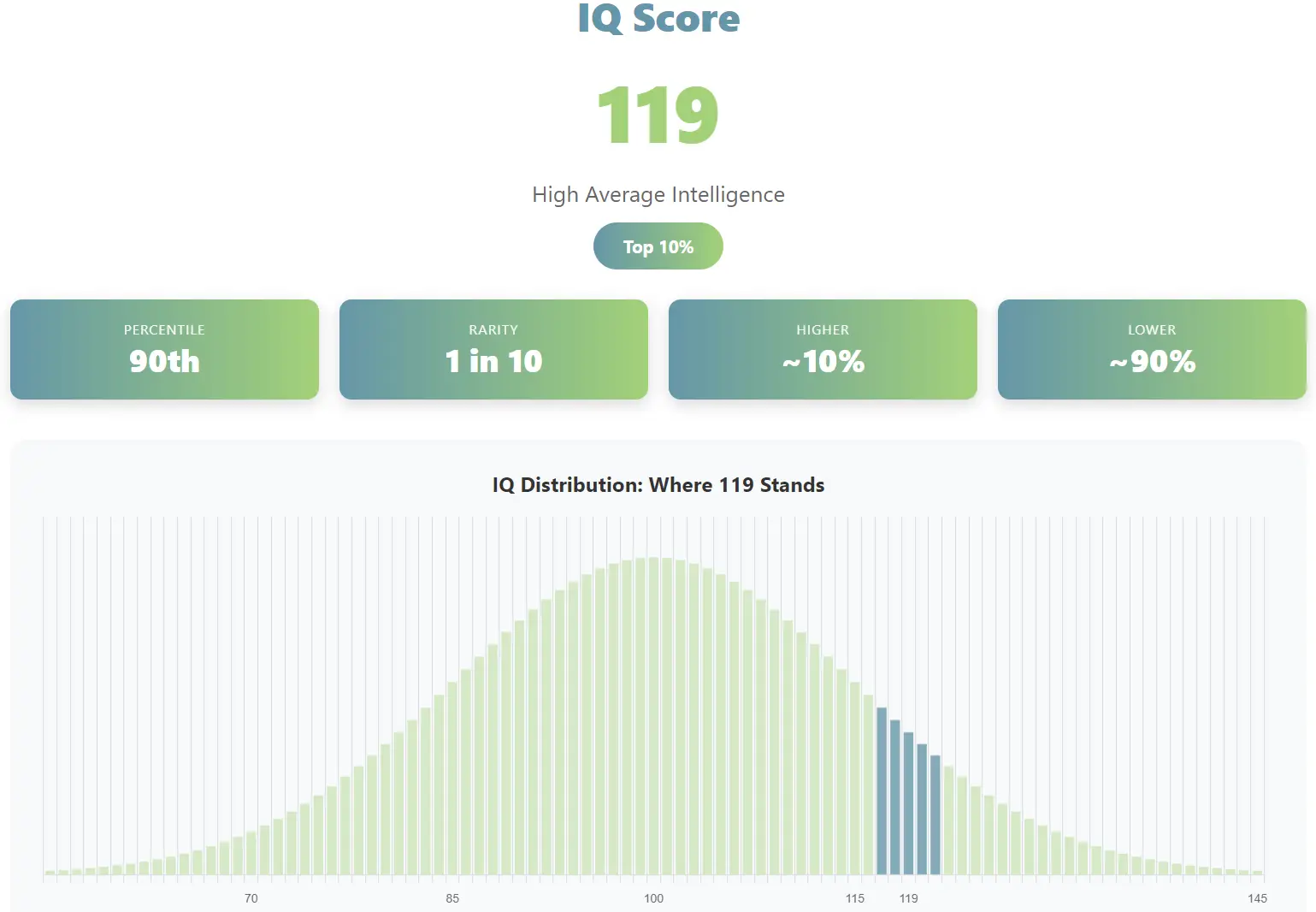
Most testing systems categorize a score of 119 as “high average” or “above average.” In statistical terms, it typically reflects:
-
Percentile rank: close to the 89th percentile
-
Rarity: around 1 in 8 people reach this level
-
Population above: roughly 11%
-
Standard deviations: just under one above the norm
In daily life, IQ 119 tends to show up in small ways rather than dramatic ones. You might notice that instructions feel intuitive or that you understand the “shape” of a concept before it’s fully explained. People may come to you with questions not because you advertise intelligence, but because you often know how to break things down cleanly.
This doesn’t mean you avoid mistakes or breeze through everything. Interest still matters; boredom still slows you down. But once you understand the framework behind something, you usually move through it with confidence.
Cognitive Tendencies Linked to IQ 119
Although people with this score vary widely, certain tendencies appear often enough to feel familiar.
Quick sense-making
You typically spot the underlying structure of a problem early on, even when the details are still fuzzy.
A need for things to be clear
Disorganized explanations can irritate you, not emotionally, but because they waste time and make the path forward harder to see.
Reliable processing
You can hold multiple pieces of information in your mind without losing track of them, though you might want time to think before responding.
Restlessness with slow pacing
If someone repeats information you already understood, your attention may jump elsewhere.
Comfort figuring things out independently
You often prefer working through something yourself rather than waiting for a step-by-step walkthrough.
Professions and Careers for IQ 119
This score supports success across a wide range of careers. Rather than narrowing choices, it tends to expand them. If you're trying to understand what type of environment fits you, frameworks like Holland career theory can help make the options feel less overwhelming.
Professional Fields
-
Teachers who translate complex ideas into digestible, practical explanations.
-
Registered Nurses who balance decision-making with hands-on care.
-
Marketing Managers who read data and understand audience behavior.
-
HR Specialists who navigate interpersonal issues with analytical clarity.
-
Financial Advisors who interpret information and help others make sense of it.
Technical and Analytical Work
-
IT Support Specialists who identify what’s really causing a problem beneath the symptoms.
-
Quality Assurance Analysts who catch inconsistencies others skim past.
-
CAD Technicians who translate instructions into accurate spatial designs.
-
Data Technicians who notice small errors before they spread.
-
Environmental Technicians who interpret samples and field data with precision.
Creative and Strategic Work
-
Copywriters who take scattered information and turn it into a clear message.
-
Graphic Designers who build visuals that feel intuitive and intentional.
-
Content Strategists who manage how information moves across platforms.
-
Event Planners who coordinate moving parts without getting lost in them.
Skilled Trades
People with this score often excel in trades where precision, pattern recognition, and mechanical intuition matter.
-
HVAC Technicians who understand airflow systems and diagnose subtle issues.
-
Automotive Technicians who trace problems back to their source logically.
-
Electricians who interpret schematics and anticipate how systems behave.

Educational Expectations
People with IQ 119 typically do well academically when their interest aligns with the material. When it doesn’t, they may perform inconsistently—not due to ability, but because motivation fluctuates.
Undergraduate level:
Most bachelor’s programs are within reach, including more demanding fields, provided you maintain steady study habits.
Master’s level:
Graduate study is feasible, especially programs centered around applied logic or structured reasoning.
Doctoral level:
A PhD is possible with sustained focus on a topic you actually care about. Persistence matters more than raw IQ.
Professional schools:
-
Law: manageable for those comfortable with reading intensity and detailed argumentation.
-
Healthcare tracks: attainable if you handle complex instructions and procedures well.
-
MBA: a good fit for people who like systems, strategy, and decision-making.
Famous People With IQ 119
Celebrity IQ claims are almost never confirmed, but discussions about highest IQ celebrities occasionally mention well-known figures whose work reflects strong learning ability or quick reasoning.
-
Tom Holland is sometimes placed in this range by fans who point to his ability to handle choreography, emotional timing, and complex stunt coordination while staying grounded on set.
-
Shawn Mendes appears in speculative lists because of his musical intuition, fast learning pace, and the way he has adapted across genres at a young age.
-
Sophie Turner is occasionally linked with this range due to her skill in navigating layered roles and her ability to read emotional shifts in scripts with unusual precision.
Learning and Development
People near this score often say they learn quickly when the topic is engaging and drag their feet when it isn’t. That contrast can create confusion, because others may expect consistency. Understanding your own patterns helps avoid frustration.
You may also refine methods naturally. Once you grasp the logic, you adjust the process until it feels efficient. That instinct is useful, though occasionally it clashes with environments that require strict procedures.
Starting new skills later in life is very realistic at this level. The main challenge is commitment—not comprehension.
What to Keep in Mind
An IQ of 119 gives you a comfortable cognitive foundation, but outcomes still depend on the choices you make and the situations you’re in. Plenty of people with similar scores move into technical fields, creative work, leadership roles, trades, or stable careers that don’t revolve around academic achievement at all.
Intelligence helps, but it doesn’t determine direction. The way you use your abilities has far more influence than the number behind them.
Want to Explore More?
Learn about your cognitive abilities, take or retake the IQ test to see how you perform.
