
What Does 118 IQ Score Mean?
Curious about an IQ of 118? Learn what this score reflects and how people in this range typically understand and process new information.
People look up an IQ of 118 for a lot of reasons. Some are checking their own test results, others are trying to make sense of a number they saw online, and a few are just curious about how scores in this range are interpreted. Whatever brought you here, IQ 118 usually describes someone who learns at a comfortable pace, grasps new material without much friction, and rarely feels lost when faced with everyday problem-solving.
This score sits in an area where thinking feels smooth but not unusual. You may understand explanations quickly or notice that you don’t need constant repetition, though nothing about it feels dramatic from your point of view. If you want a clearer sense of where IQ 118 falls overall, it helps to see how it fits into the broader IQ test range.
What Does an 118 IQ Score Mean?
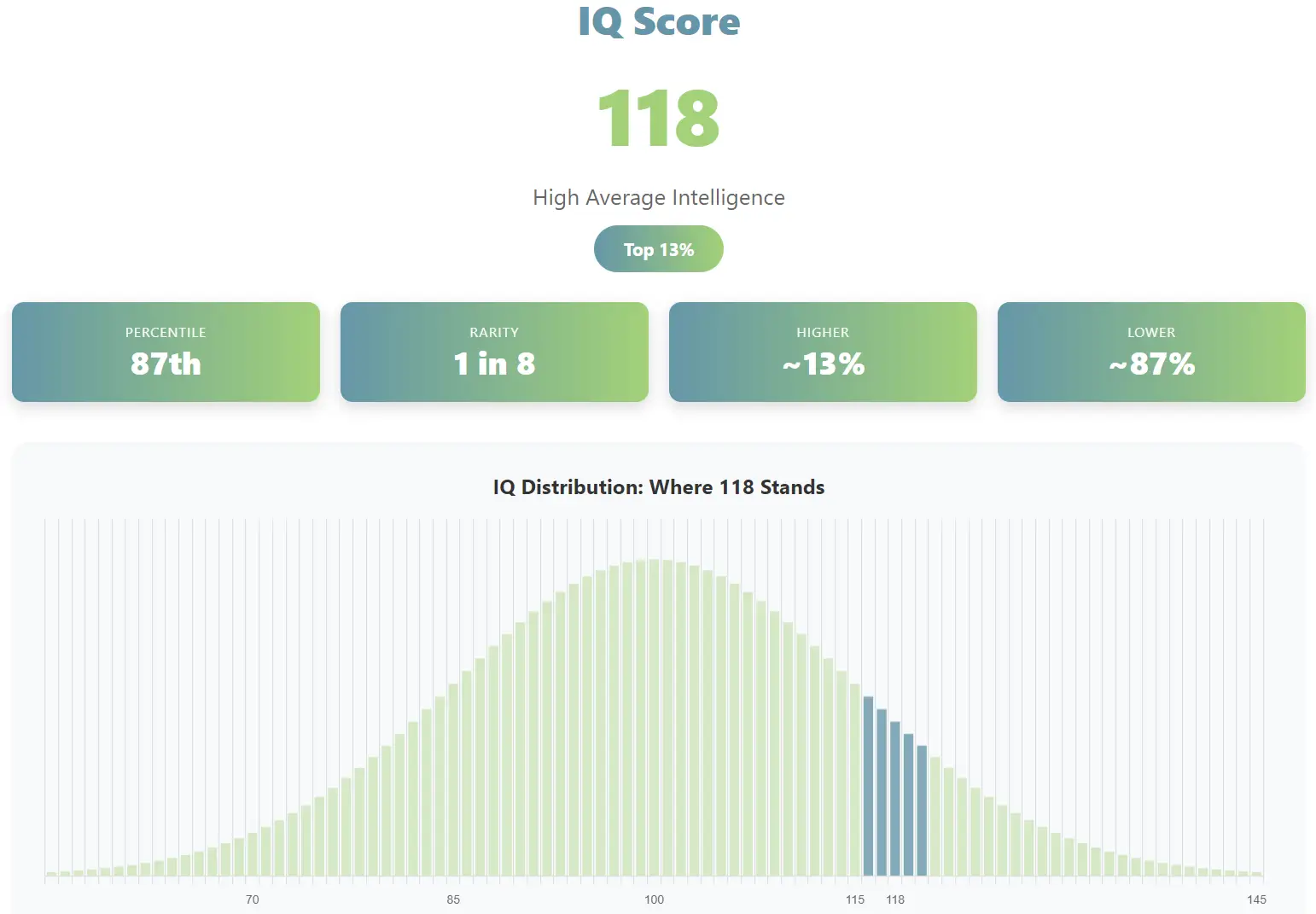
Different tests categorize IQ 118 slightly differently, but most place it toward the top of the “above average” band. Statistically, it tends to sit around:
- Percentile rank: roughly the 87th percentile
- Rarity: about 1 in 7 people
- Population above: around 13%
- Standard deviations: a bit under one above average
In real life, the score often shows up in the way you process information. You might catch the point of an idea early, even when the explanation is still unfolding. Instructions usually make sense the first time through, unless they’re written poorly. You also might find that unfamiliar material feels less intimidating to you than it seems to others.
But the number doesn’t magically create motivation. If a topic feels irrelevant or slow, you may lose interest despite understanding it easily. That reaction is common in this band.
Cognitive Tendencies Linked to IQ 118
People who score around 118 don’t think in identical ways, but a few tendencies show up often enough to mention.
A quick grasp of overall structure
You may understand the shape of a concept early on, even if the details are still coming together.
An instinct for filtering information
You usually know what’s relevant and what isn’t, which shortens your learning time.
Steady reasoning ability
You can follow explanations without losing the thread, even when they bounce around a bit.
Frustration with slow pacing
If someone repeats information you already absorbed, your mind may drift.
A strong preference for independence
You often prefer figuring things out yourself rather than sitting through slow or unclear instructions.
Professions and Careers for IQ 118
This score doesn’t restrict you to a narrow list—it usually expands your options. What matters more is whether you prefer structured tasks, flexible environments, hands-on work, or something social. Frameworks like Holland career theory can help sort out those differences.
Professional Fields
- Occupational Therapists who combine reasoning with practical problem-solving.
- Project Coordinators who keep moving pieces aligned without micromanagement.
- PR Specialists who adapt quickly to changing situations.
- Business Analysts who interpret patterns and propose improvements.
- Registered Dietitians who turn scientific guidance into real-life plans.
Technical and Analytical Work
- IT Coordinators who understand systems and troubleshoot calmly under pressure.
- Lab Technicians who notice irregularities others overlook.
- Database Assistants who maintain accuracy across large information sets.
- Surveying Technicians who work with spatial data and field measurements.
- Compliance Technicians who verify whether procedures match required standards.
Creative and Strategic Work
- Social Media Managers who adapt to fast-changing formats and audience behavior.
- Video Editors who assemble stories from chaotic raw material.
- UX Writers who simplify instructions so people don’t get stuck.
- Brand Coordinators who keep messaging consistent across different channels.
Skilled Trades
Many people with higher-than-average reasoning ability thrive in trades where precision and pattern recognition matter more than theory.
- Appliance Technicians who diagnose issues based on subtle symptoms.
- Telecommunications Technicians who work with systems that require logic and timing.
- Construction Estimators who calculate materials and timelines with accuracy.

Educational Expectations
Most people with an IQ of 118 perform well academically when they stay engaged. They can understand challenging material, but consistency—not ability—creates the biggest differences in long-term outcomes.
Undergraduate level:
Bachelor’s programs across many fields are realistic. Technical majors are manageable with steady study habits.
Master’s level:
Graduate programs involving applied reasoning or structured analysis are a comfortable fit.
Doctoral level:
A PhD is possible if the topic genuinely interests you and you’re willing to commit to a long project.
Professional schools:
- Law: doable with discipline and strong reading stamina.
- Healthcare programs: attainable for people who stay organized.
- MBA: a good match for those who enjoy planning, strategy, and systems thinking.
Famous People With IQ 118
Celebrity IQ numbers are nearly always speculative, but conversations about highest IQ celebrities occasionally include individuals whose work suggests strong learning ability.
- Rami Malek is sometimes placed in this band because of the subtle complexity he brings to his roles.
- Hailee Steinfeld appears in estimates thanks to her versatility across acting and music.
- Michael B. Jordan is occasionally mentioned due to his disciplined approach to character work and production.
Learning and Development
People around this score often learn quickly when the topic feels meaningful. When it doesn’t, progress slows—not from difficulty, but from lack of interest. This mismatch can confuse others, because your performance shifts depending on how much you care.
Once you grasp a process, you might adjust it to make it smoother. That tendency is useful, though it can clash with environments that require strict adherence to existing procedures.
Learning new skills later in life is very realistic for people in this range. The first phase usually feels awkward, but comprehension isn’t the issue.
What to Keep in Mind
An IQ of 118 gives you a strong starting point for academic work, career development, and practical problem-solving. But life outcomes depend heavily on your habits, interests, and environment. People with similar scores end up in a wide variety of roles—technical jobs, creative fields, leadership positions, trades, and careers that prioritize stability rather than complexity.
The score helps, but it doesn’t steer the ship. The direction you choose and the consistency you bring matter far more.
Want to Explore More?
Learn about your cognitive abilities, take or retake the IQ test to see how you perform.
First and world's best testing platform. For everyone who has questions about themselves and wants answers too
Company BM
Vitosha Blvd 66, floor 4, 1463 Sofia
2026